Tottenham, Ontario: The Railway Town Asks What Comes Next
The fastest-growing corner of a fast-growing town
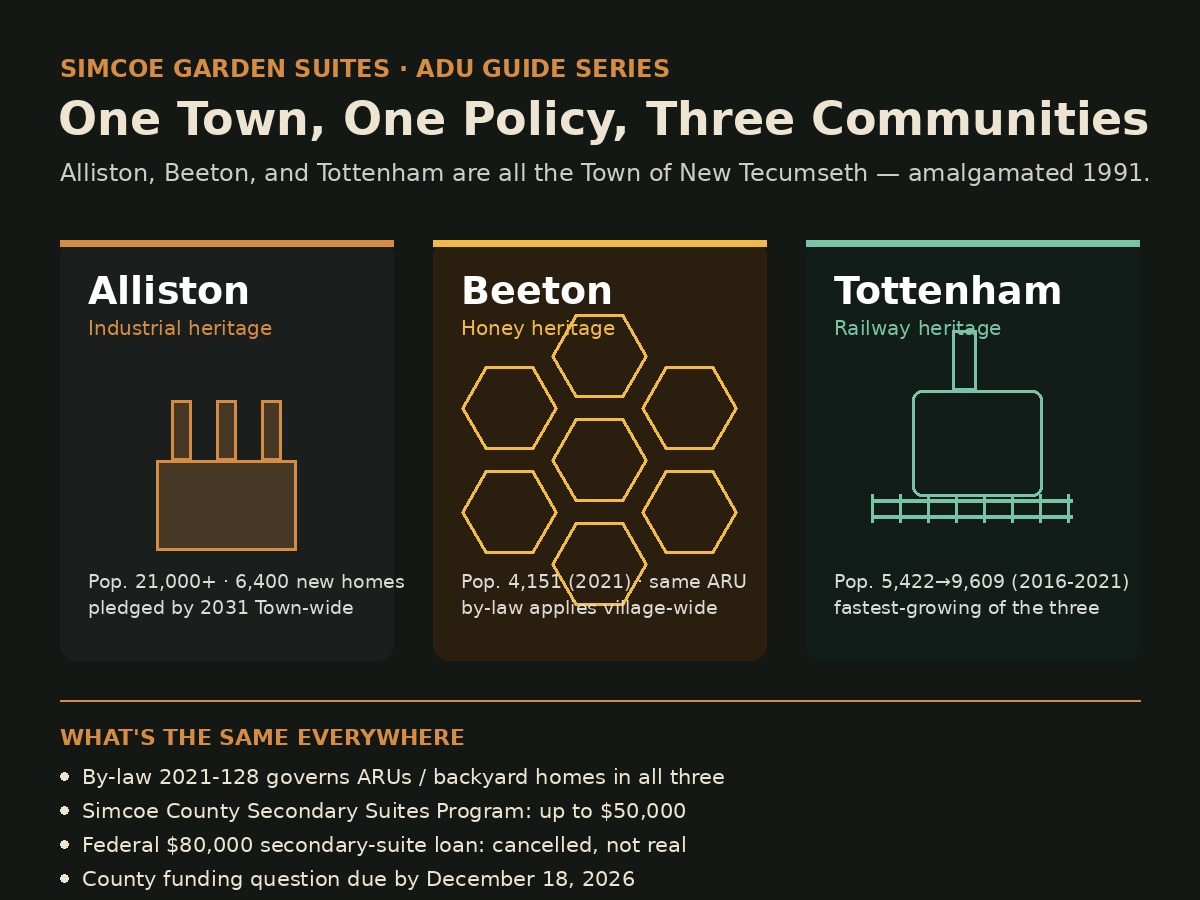
Tottenham is the part of New Tecumseth that is already living the future the Town's Municipal Housing Pledge describes. Between the 2016 and 2021 census, Tottenham's population jumped from 5,422 to 9,609, nearly doubling in five years as three new subdivisions filled in around the historic core. The South Simcoe Railway, Ontario's oldest operating steam heritage railway, still runs out of the 1904 station on Mill Street West, and the 41-acre Tottenham Conservation Area still anchors the old village. But the newest streets in Tottenham look nothing like the streets around the station, and that gap, between a heritage village and a subdivision boomtown, is exactly where the Additional Residential Unit (ARU) conversation starts to matter.
Tottenham sits roughly 20 minutes from both Alliston and Beeton, inside the same single municipality, the Town of New Tecumseth, formed in 1991 when Alliston, Beeton, Tottenham, and Tecumseth Township amalgamated. The same By-law 2021-128 that governs a backyard home in Alliston or a garden suite in Beeton governs one in Tottenham. The same 6,400 new homes by 2031 pledge covers all three. What changes town to town is not the rules. It is which kind of growing pain shows up first, and in Tottenham, that pain is speed: a community that doubled in five years, asking whether its own quiet backstreets can still add a second home without losing what made people move there in the first place.
A town that has already grown once this decade
New Tecumseth's own numbers tell the story Tottenham is living. Town-wide population went from 34,242 in 2016 to 43,948 in 2021, and Statistics Canada's 2025 estimate puts it at 50,739. Most of that growth did not come from a single large subdivision pitched by a developer. It came from thousands of individual decisions, additions, severances, and now, increasingly, Additional Residential Units added to existing lots. The Town's Municipal Housing Pledge commits to roughly 6,400 new homes by 2031. An ARU on an existing lot in a built-up part of Tottenham counts toward that number just as much as a new house in a subdivision, without requiring new roads, new water lines, or a new school. Separately, the province's Town for Everyone survey, open until December 18, 2026, is gathering resident input on local housing needs across New Tecumseth.
What the rules actually say
Under By-law 2021-128, a homeowner in Tottenham can generally add up to two Additional Residential Units (ARUs), commonly called backyard homes or, by some long-time residents, still garden suites, up to three homes on one lot in total, whether inside the existing house (a basement or attached-unit conversion) or as a separate detached structure in the backyard, subject to lot coverage, setback, parking, and servicing requirements that apply the same way across New Tecumseth. The rules are not unique to Tottenham's newer subdivisions or its older streets near the station; they apply lot by lot, based on size and servicing, not neighbourhood age.
What residents report finding hardest is not the rule itself but confirming, for their specific lot, what applies: septic versus municipal sewer in some of the older sections, drainage easements near the Conservation Area, and whether a given street has the municipal water capacity new subdivisions were built with. The by-law is public. Whether an individual homeowner can act on it without hiring a planner just to find out is the open question.
Growing fast and building piecemeal
Tottenham's recent growth came in distinct waves: three new subdivisions built out largely in the past decade, layered onto a village core that dates to the 1800s and still has a working heritage railway running through it. In the newer subdivisions, servicing (water, sewer, drainage) was built to current standards, so adding a backyard home is often more straightforward from an infrastructure standpoint. In the older core near the station and the Conservation Area, lots are frequently larger but servicing is older, and a homeowner may need to confirm septic capacity or drainage easements before a second unit is approved.
The practical result is that two neighbours in Tottenham, one in a subdivision built in 2015 and one on a street that predates the railway station, can face genuinely different approval paths under the exact same by-law. That is what happens when a single ARU policy is applied across a town that grew in several very different eras at once.
What to call it, and why that is not just wording
Ontario's Planning Act, under section 39.1, treats a garden suite as a specific, defined category: a temporary residential unit, often tied to a time-limited agreement with the municipality. An Additional Residential Unit (ARU), by contrast, is the broader, generally permanent category most backyard or basement units fall under today. Calling every second unit a "garden suite" risks implying rules, such as the temporary agreement, that may not actually apply to a given project.
Many Tottenham residents, like residents across New Tecumseth, still use garden suite in everyday conversation, and that is the phrase people search for. This piece uses backyard home and ARU in describing the legal category, and keeps garden suite where it matches how residents actually talk and search, including in the FAQ below.
Money: what is real, and what isn't
The Simcoe County Secondary Suites Program offers up to $50,000 toward an eligible secondary unit, the same program available to homeowners in Alliston and Beeton. Confirm current eligibility and remaining budget directly with Simcoe County, since program terms and funding can change year to year.
A federal co-investment loan of up to $80,000 for secondary suites has been cancelled and should not be assumed to still be available; it is a separate matter from Ontario's HST rebate on eligible ADU construction, which remains real and is worth confirming with the Canada Revenue Agency. For a fast-growing community like Tottenham, where many residents are already carrying a recent-purchase mortgage on a subdivision home, the gap between what a build actually costs and what any single program covers is worth calculating before committing to a project, not after.
Keeping a growing town's own people
A town that nearly doubled in five years can grow in two very different ways: by importing new residents into new subdivisions, or by also letting its existing residents expand in place.
An ARU built by local trades, for a grown child who wants to stay near the South Simcoe Railway and the Conservation Area rather than buy into a subdivision an hour away, or for a parent who helped build the Tottenham of the 1990s and wants to stay close to family, keeps both money and people in the community Tottenham already has, instead of only adding new ones.
The ask
Tottenham does not need to choose between its heritage railway and its newest subdivisions. It needs the same thing Alliston and Beeton need: clear, predictable ARU rules a homeowner can read once and trust, a straight answer about servicing differences between the older core and the newer subdivisions before a homeowner pays for drawings, and a public answer about whether the Simcoe County Secondary Suites Program will still be funded in the new year.
A town that doubled once this decade is going to keep changing. The question is whether its own residents, old streets and new ones alike, get to be part of how.
Frequently asked questions
Can I build a garden suite in Tottenham? If your lot meets New Tecumseth's Additional Residential Unit (ARU) standards under By-law 2021-128, yes, whether you're in one of the newer subdivisions or the older village core near the train station. Confirm your specific lot's servicing (municipal versus septic, drainage near the Conservation Area) with the Town's planning department before finalizing a design.
Why did Tottenham grow so fast? Tottenham's population rose from 5,422 in 2016 to 9,609 in 2021 as three new subdivisions were built around the historic village. That growth is part of New Tecumseth's broader rise, from 34,242 residents in 2016 to an estimated 50,739 in 2025, and the Town's Municipal Housing Pledge targets roughly 6,400 new homes by 2031 town-wide.
Is there still an $80,000 federal grant for a secondary suite? No. That federal co-investment loan was cancelled. A separate, real program, Ontario's HST rebate on eligible ADU construction, still exists; confirm current eligibility with the Canada Revenue Agency.
What funding can I actually count on? The Simcoe County Secondary Suites Program offers up to $50,000 toward an eligible secondary unit as of this writing. Confirm the deadline and remaining budget with Simcoe County, since program terms and funding can change year to year.
Related reading
This article is part of a series on New Tecumseth's three communities: Alliston, the industrial town and Beeton, the honey capital. For the funding details in full, read ARU Funding in Ontario: What Actually Exists in 2026. To check your own property, use the free Check Your Backyard tool, or learn more about the Garden Suite design.