Alliston, Ontario: An Industrial Town Asks What Comes Next
A town built on potatoes and precision manufacturing
Alliston is the largest of the three urban centres that make up the Town of New Tecumseth, the other two being Beeton and Tottenham, about an hour north of Toronto and a few minutes west of Highway 400. At the 2021 Census, Alliston itself counted 23,253 people and the Town as a whole 43,948, up 28.3 percent from 34,242 in 2016. The Town is planning for 80,590 residents by 2051.
Alliston grew up as the trading town for the farmers around it, known above all for potatoes, and that history still gets celebrated every August at the Alliston Potato Festival, a family event running since 1973 on Church Street, first proposed in 1972 by Davis Willis and backed from day one by the Alliston Rotary Club and the Alliston Lions Club. The festival is a living part of the town's identity, not a museum piece.
Alliston is also, unmistakably, an industrial town. Honda Canada has built cars here since November 1986, 40 years this year. The Alliston plant employs 4,200 people, builds the Honda Civic (Plant 1) and the Honda CR-V (Plant 2), and produced more than 400,000 vehicles in 2025. Honda describes itself as Canada's second-largest automaker by production volume. The town's other major manufacturer is Baxter Corporation, whose Alliston facility is the only large-scale plant in Canada producing critical intravenous and dialysis solutions. Stevenson Memorial Hospital is the community's hospital.
And Alliston is a town a lot of people drive past without noticing how good-looking it is. Earl Rowe Provincial Park sits just west of town, 312.42 hectares, established in 1964, with hiking trails, camping, and Earl Rowe Lake for boating, kayaking, and fishing, plus the Boyne River running through it, good for salmon watching in the fall. The Boyne itself runs through Alliston proper; the Nottawasaga River is just east of town. The Bannockburn Heritage Park, the Alliston and District Museum, the Trans Canada Trail, and the Tottenham Conservation Area round out the town's attractions.
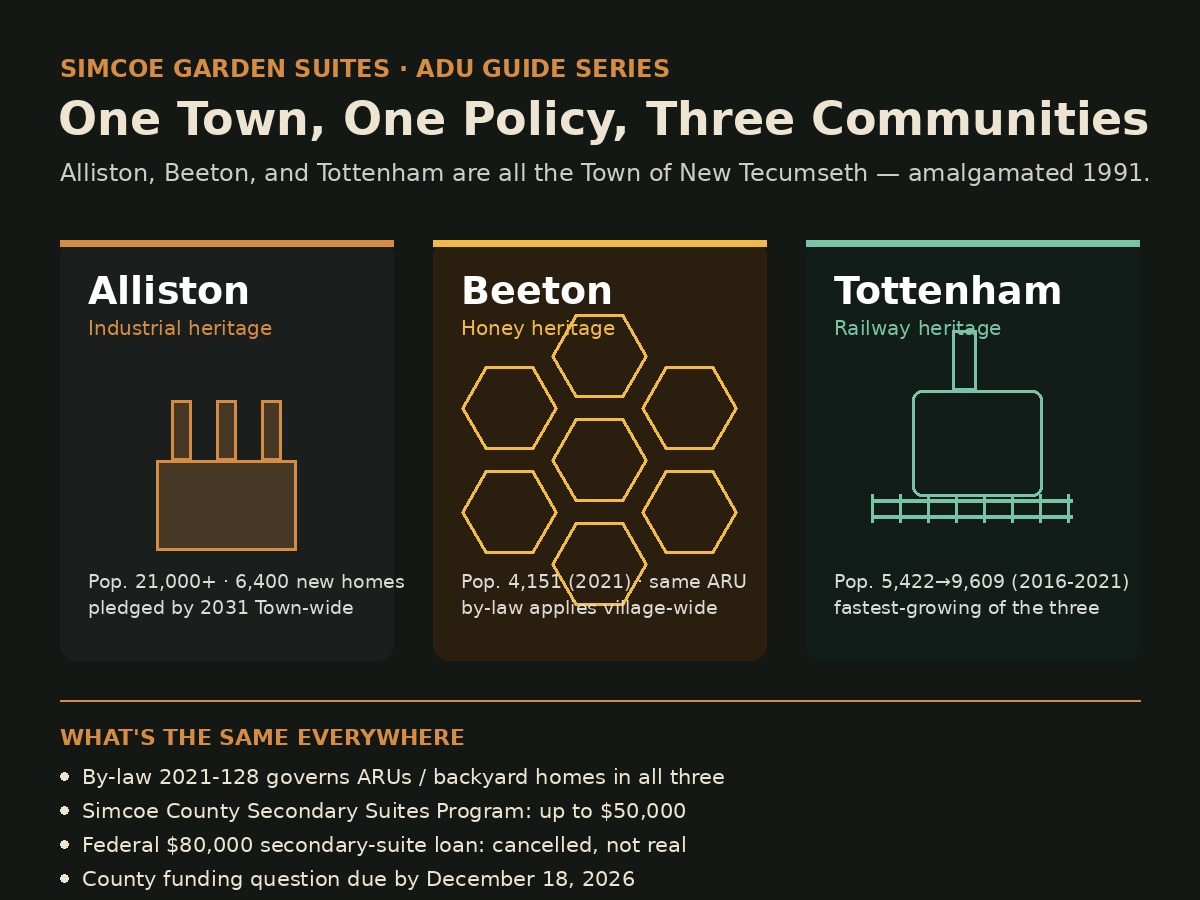
This piece focuses on Alliston, but it applies just as much to the rest of New Tecumseth. Alliston, Beeton, and Tottenham are one municipality, governed by the same council, the same zoning bylaw, and the same housing pledge, and none of the three is more than about 20 minutes from the other two. The 6,400-home commitment, the ARU rules, the County funding, and the water constraint described below apply to a homeowner in Beeton or Tottenham exactly as they apply to one in Alliston. Dedicated pieces on Beeton and Tottenham are part of the same series.
A workforce that doesn't live where it works
Alliston's economy runs on people who make things, and a lot of those people don't live where they work. The Town's own numbers, for New Tecumseth as a whole, are striking: 7,165 residents leave town every day for work, while 5,655 live and work inside the Town; 6,205 residents commute outside Simcoe County entirely for their jobs; and 65 percent of the Town's workforce lives outside it. Run the comparison the other way and it gets sharper still: more than 5,000 auto manufacturing jobs sit inside the Town, while only 3,300 New Tecumseth residents work in auto manufacturing. The jobs are here. A large share of the people filling them are commuting in from somewhere else.
These are Town-wide figures, not Alliston-specific ones, but the pattern shows up in Alliston itself too. Rental listings in town routinely advertise proximity to the Honda plant. Workers already want to live close to their jobs. Housing that lets them do that is the missing piece. A long commute costs the worker time and money every day, and it costs the region the spending, volunteering, and community life of people who drive away every evening.
That is the context that makes the Town's growth plans matter. New Tecumseth is planning for 80,590 residents and roughly 31,000 jobs by 2051. Growth at that scale needs somewhere for the workforce to live, not twenty years from now, but as the jobs arrive.
The Town has already put a number on this
New Tecumseth's own policymakers have already reached this question and put a number on it. In March 2024, council committed to facilitating 6,400 new homes by 2031 under the province's Municipal Housing Pledge, six months after voting against signing it. That reversal is part of the public record and it matters: the pledge was accepted with eyes open, and staff reports at the time warned that hitting it would depend on securing water from Collingwood.
The need behind that number is documented in the Town's own 2025 Housing Needs Assessment. The average resale home in 2025 cost roughly $850,000, while an affordable home at the Town's median household income would run about $410,000. Fewer than one household in ten earns enough to buy at the average price. Roughly one household in nine lives in housing that is unaffordable, overcrowded, or in need of major repair. In July 2024, council, on a motion brought by then-Deputy Mayor Stephanie McLellan, now the sitting mayor, resolved that the Town "recognizes that access to affordable housing is a human right, a necessity of life, and a fundamental element in achieving a just, prosperous, and sustainable community," and that the shortage of affordable housing options "has reached a critical level affecting our workforce."
The Town is asking residents directly, right now, what housing is missing. The Town for Everyone survey, a housing needs and direction survey, is open until December 18, 2026 at newtecumseth.ca/TownforEveryone. That's the live, open door for this conversation.
One thing the Town has already shown is that it will say no to growth on the wrong terms. When the province consulted in April and May 2026 on roughly 30,000 additional homes across about 2,949 hectares in South Simcoe, six projects touching New Tecumseth, council rejected that proposal unanimously, 10 to 0, on April 29, 2026, and called it, in its letter to the province, "a clear and unambiguous rejection": 30,000 homes, but only about 980 jobs attached to them. The message was that growth has to come with jobs, infrastructure, and local input.
Water: the limit the Town is already working to fix
None of this can be wished away, because the binding constraint is water, and the Town says so itself. In May 2023, council ordered that residential subdivision and site plan applications in Alliston and Beeton be held back from final approval until the Town has enough water. The Town's 2025 Housing Needs Assessment repeats this plainly: "the lack of available water is a significant challenge to advancing residential development approvals in the Town."
The numbers make the constraint concrete. Alliston's water system has current capacity of 24,705 cubic metres a day, 9,500 from the Collingwood pipeline and 15,205 from wells, against average demand of 11,536 cubic metres a day in 2024 and a peak day of 16,098. The Town's own December 2025 water demand update says forecast peak-day demand in 2025 and 2030 reaches the system's fixed capacity.
The long-term fix is underway and it is large. The Town is paying 63 percent, $173 million, of the roughly $270-million expansion of the Raymond A. Barker Water Treatment Plant in Collingwood, which will supply New Tecumseth through a transmission line roughly 57 kilometres long. The first additional water from that expansion, originally slated for August 2029, had slipped by 242 calendar days as of June 2026. This is not a criticism of the project. It is the reason the Town's own reports say growth has to be timed carefully, and the reason any housing idea for Alliston has to answer the water question first.
The middle path: additional residential units
Between the commitment to build 6,400 homes and the limit water puts on all of them sits a tool the Town already has, already allows, and rarely discusses as a strategy: the Additional Residential Unit (ARU), also called an ADU (Accessory Dwelling Unit) outside Ontario. Most residents know it by a more familiar name, a backyard home (what a lot of people still call a garden suite, a coach house, or a tiny home). The Town's zoning By-law 2021-128 allows up to two ARUs on a lot with a detached, semi-detached, or street townhouse home, up to three homes on one lot in total. A detached backyard home is capped at 50 percent of the principal building's floor area, up to a maximum of 80 square metres, must sit on a permanent foundation, must connect to municipal services wherever the principal home does, and must be set back at least 1.2 metres from the rear and side lot lines. The first ARU needs one parking space; the second needs none.
The important part is that the Town already has a servicing rule built for exactly this case. Its Servicing Allocation Policy, approved in May 2023 and in effect since June 1, 2023, sets aside a portion of water and sewer capacity specifically for additional residential units, allocated on a first-come, first-served basis. Once that portion is used, further units depend on the Town engineer's discretion and whatever capacity remains, and a unit cannot reach a building permit until capacity is available. The size of that set-aside is not published. But the structure is the point: the Town has already decided that backyard homes deserve protected capacity, because they are small, incremental, and built mostly for people who already live here.
That is what makes an ARU the middle path. Most backyard homes are for families already in the house: a grown child keeping their independence while staying close, or an aging parent cared for nearby instead of far away. The Town's own ARU page lists exactly these benefits: housing family members in their own space, multigenerational living and aging in place, adding affordable housing options to existing neighbourhoods, and rental income to help homeowners with their mortgage. A backyard home does put pressure on the water system, and that has to be faced honestly. But it adds that pressure gradually, lot by lot, for people who are already part of the community, not thousands of units all at once on undeveloped land.
It's also worth noticing how little of this has actually happened. Only six County-funded secondary units have been built in New Tecumseth since 2015, compared with 104 in Barrie. And in council's own work, garden suites have come to the table almost entirely as one-off temporary-use applications, a 20-year temporary permit for a single lot at a time, not as a housing strategy. The tool exists in the bylaw. It hasn't yet been discussed as one.
Money: what is real, and what isn't
If residents are going to take backyard homes seriously, they need straight answers about money, including one widely repeated figure that is simply wrong.
First, the real money. The Simcoe County Secondary Suites Program offers up to $50,000 per unit to build a secondary unit or garden suite, structured as a 15-year forgivable loan, forgiven in equal amounts each year, with no payments and no interest as long as the agreement is honoured. It is often called a grant; it isn't one, it's a forgivable loan with conditions. The unit has to be rented for 15 years at or below the County's maximum affordable rent, which in New Tecumseth for 2025-26 is $1,020 a month for a studio or bachelor unit, $1,426 for a one-bedroom, and $1,568 for a two-bedroom, utilities included, to a tenant under the County's income ceiling, and the owner has to apply before construction starts. Intake runs year-round, first-come, first-served, and funding is limited.
Second, the money that doesn't exist. Ottawa announced a federal secondary suite loan, up to $80,000 at 2 percent over 15 years, twice in 2024, and never opened applications. Budget 2025, tabled November 4, 2025, confirmed it "will not proceed." This isn't money a homeowner can apply for. The federal financing that does exist is insured mortgage refinancing up to 90 percent of a home's post-renovation value, up to $2 million, over a 30-year amortization, available since January 15, 2025. For a senior or a relative with a disability, there is also a federal tax credit worth up to $7,250. And for a rental unit, Ontario's enhanced HST rebate can return up to $80,000 of provincial HST per unit, a different $80,000 from the dead federal loan and not to be confused with it, as long as construction starts by March 31, 2027.
Third, the outdated figure still circulating. The County loan was $30,000 through the 2024-25 program year before it rose to $50,000. The old $30,000 figure is still sitting on multiple websites, including older County pages. Anyone budgeting off $30,000 is budgeting off stale information.
There is no grant from the Town of New Tecumseth itself for a backyard home. The money available to an Alliston homeowner comes from the County, the province, and the federal government, and it is real, once the conditions are understood.
One honest gap remains: cost. Published Ontario guides for a typical backyard home vary widely, roughly $150,000 to $650,000, because cost depends on size, distance to services, foundation type, and finishes. Readers should treat any single number with caution, including the ones in these guides.
Building locally: keeping jobs and young people here
There's a second, quieter argument for backyard homes in Alliston, and it's about where things get built. If additional units are built locally, using the spare capacity of local shops and local labour, the money stays here, the skills stay here, and the young people learning those skills stay here too. A housing policy that also builds local capacity is worth more than one that only adds roofs.
It's also an argument for keeping the region's young people in the region. A grown child who can live independently in a backyard unit, close to family and close to work, doesn't have to leave Alliston to find their first home. A parent who can live nearby, in their own space, doesn't have to move away from the community they helped build. Keeping people is how a town keeps itself.
The ask
This article isn't proposing any system, product, or plan. It is asking New Tecumseth and Alliston policymakers to do three things, and to do them openly.
Take additional residential units seriously as a housing strategy, not just as one-off applications, but as a deliberate, measured part of reaching the 6,400-home pledge inside the water the Town actually has. The bylaw already allows them. The servicing policy already sets aside capacity for them. The County already funds them. What's missing is a policy conversation about them.
State plainly how much water capacity is set aside for ARUs, and what its status is, so a homeowner thinking about a unit for a parent or a grown child knows whether capacity is available before spending money on drawings.
Use the housing strategy work already underway. The survey is open until December 18, 2026. Hear from the families actually living in these arrangements: grown children, aging parents, and the workers who drive in every morning and would rather live here.
Alliston is an industrial town with a farming heritage, a beautiful river valley, a workforce that commutes a long way, and a council that has already committed to building more homes and already said no to growth on the wrong terms. The middle path is already written into the Town's own rulebook. It deserves to be taken seriously.
Frequently asked questions
Can I build a garden suite in Alliston? It depends on your lot. Start with zoning: is a detached ARU (what most people call a garden suite) permitted in your zone? Then check whether the unit physically fits (setbacks, backyard size), then servicing (water and sewer, a real constraint in parts of New Tecumseth). The Town's ARU page is the starting point; confirm zoning with Planning at planning@newtecumseth.ca and apply for a building permit through building@newtecumseth.ca. Use the free address-by-address check at simcoegardensuites.ca.
What is an Additional Residential Unit (ARU), and is it the same as a garden suite? Residents say "garden suite"; the Town says "Additional Residential Unit." A garden suite is one type of ARU, a detached second home in the backyard with its own kitchen, bathroom, and entrance. Other types include a basement apartment or in-law suite, a coach house or laneway home, and an addition to an existing house.
Is a garden suite legal in Ontario? Yes, in principle. Since November 2022, provincial legislation allows up to three residential units on most serviced residential lots. The details, setbacks, size, servicing, are set by the municipality, not the province.
How many units can I have on my lot in Ontario? Up to three in total, where the municipality allows it: the principal home plus up to two ARUs, for example one attached and one detached, or two attached.
Do I need a permit to build a garden suite in New Tecumseth? Yes, a building permit, and the unit has to meet the Ontario Building Code. Confirm zoning with Planning first, then apply to building@newtecumseth.ca.
How much does it cost to build a garden suite in Ontario? There's no single reliable figure. Published Ontario guides for typical builds range roughly from $150,000 to $650,000 and disagree with each other; cost depends on size, distance to services, foundation, and finishes. There is no Alliston-specific cost figure.
Is the $80,000 Canada garden suite loan still available? No. It was announced in 2024, doubled to $80,000 that December, never opened for applications, and Budget 2025 (tabled November 4, 2025) confirmed it will not proceed. The federal financing that is actually available is insured mortgage refinancing up to 90 percent of post-renovation home value.
Is there a grant to build a garden suite in Simcoe County? Not a grant, a 15-year forgivable loan of up to $50,000 from Simcoe County, for a unit rented affordably for 15 years. It was $30,000 through the 2024-25 program year. Apply before construction starts; intake is year-round, first-come, first-served, and funding is limited.
Do I pay development charges on a garden suite in Ontario? Additional residential units are exempt from municipal development charges under provincial rules; the Town confirms this address by address. Building permit fees still apply.
Can I rent out my garden suite in Alliston? Yes, if the unit is legal, and if it was built with County funding the rent has to stay at or below the County's maximum affordable rent for 15 years. A garden suite can't be severed or sold separately from the main lot.
Can I rent my garden suite on Airbnb? Short-term rentals are prohibited under the federal insured-refinancing path (no rentals under 90 consecutive days), and the County program requires long-term affordable rent. Check the Town's rules before assuming a short-term rental is allowed.
How long does it take to get a garden suite permit in New Tecumseth? There's no published timeline for New Tecumseth. The Town's process is: confirm zoning with Planning, then apply to Building.
Related reading
This article is the first of a series on New Tecumseth's three communities: Beeton, the honey capital and Tottenham, the railway town. For the funding details in full, read ARU Funding in Ontario: What Actually Exists in 2026. For the local-jobs argument, read The Hidden Economic Potential in Canada's Backyard Home Policy. To check your own property, use the free Check Your Backyard tool, or learn more about the Garden Suite design.