The Hidden Economic Potential in Canada's Backyard Home Policy
Updated: Nov 8

The legislation that paved the way for building backyard homes in Canada is, in my view, one of the more thoughtful housing policy decisions of recent years.
The stated goal was straightforward: help address the housing shortage by making use of infrastructure that already exists. But there's a second layer to this decision that gets less attention: when building a small residential unit involves dozens of different trades, from design and engineering to materials supply and local construction, it creates real cash flow within the middle class. That's exactly the kind of small engine the housing industry, as one of the economy's key drivers, relies on.
I recall witnessing something similar years ago: during a severe economic downturn, shopkeepers in a place I lived were ordered, at minimal cost, to build a small platform or garden in front of their stores. The stated purpose was urban beautification and more green space; but what it actually did was quietly spark a small economic engine that helped the local economy get through the downturn.
I think the same logic, at a larger scale, is behind Canada's recent decision too — whether or not that side effect was consciously intended.
Even so, in practice, this policy hasn't become as widespread as expected. A CBC report (March 2024) found that of 244 garden suite applications in Toronto over two years, only 6 were completed; Glyn Holmes, a co-founder of Resimate, says directly that demand exists, but cost and complexity are the main barriers.
In my view, the main reasons for this gap between policy and execution come down to a few things: many homeowners simply aren't aware the law exists; among those who are aware, many don't know what support programs and incentives are available; and for those who know both, there's uncertainty about the practical details — tax implications, real costs, zoning rules, the possibility of neighbour disputes, and the lack of a single, clear resource to guide the whole process. There are companies that handle the entire process start to finish, but the final price is often out of reach for the average homeowner.
Fortunately, this remains a focus for federal policymakers, as we saw in the Deputy Prime Minister's remarks (Chrystia Freeland, December 2024).
I believe it's exactly these bottlenecks that hide significant economic potential — potential worth the time and focus to address. That's what I work on: building a feasibility tool and legal pathway guide, as well as a buildable hardware design. If you work in this space or are interested in it, whether in government or the private sector, I'd be glad to connect.
See it up close, town by town
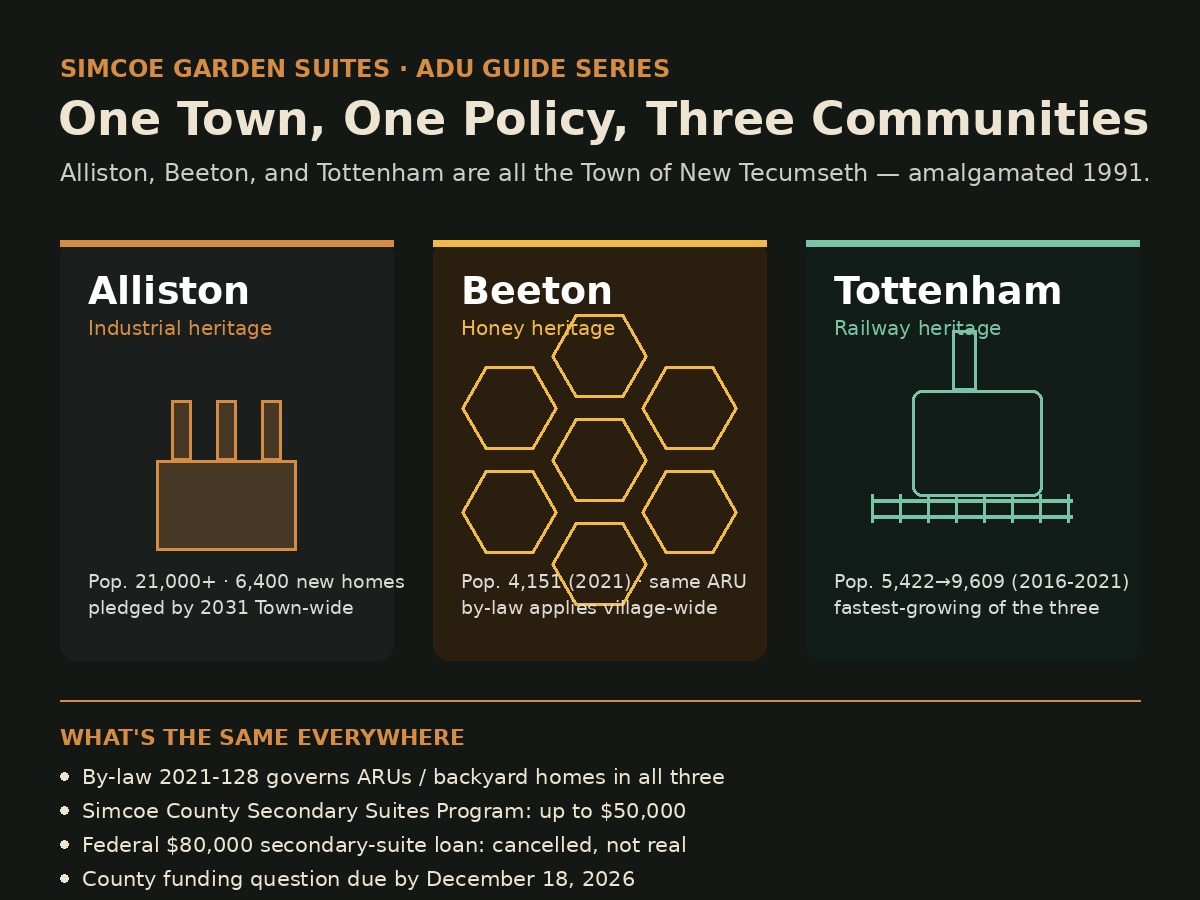
For what this looks like on the ground in New Tecumseth, read the local guides for Alliston, Beeton, and Tottenham, or check your own address with the free Check Your Backyard tool.